Locking style: arm stretch
Music-to-Dance Generation via Atomic Movements
Abstract
Music-driven dance generation should produce motion that is rhythmically synchronized with music while preserving coherent choreographic structure. Existing end-to-end methods usually model dance as a continuous signal and overlook its compositional nature. We instead represent choreography as a sequence of semantically interpretable and reusable atomic movements.
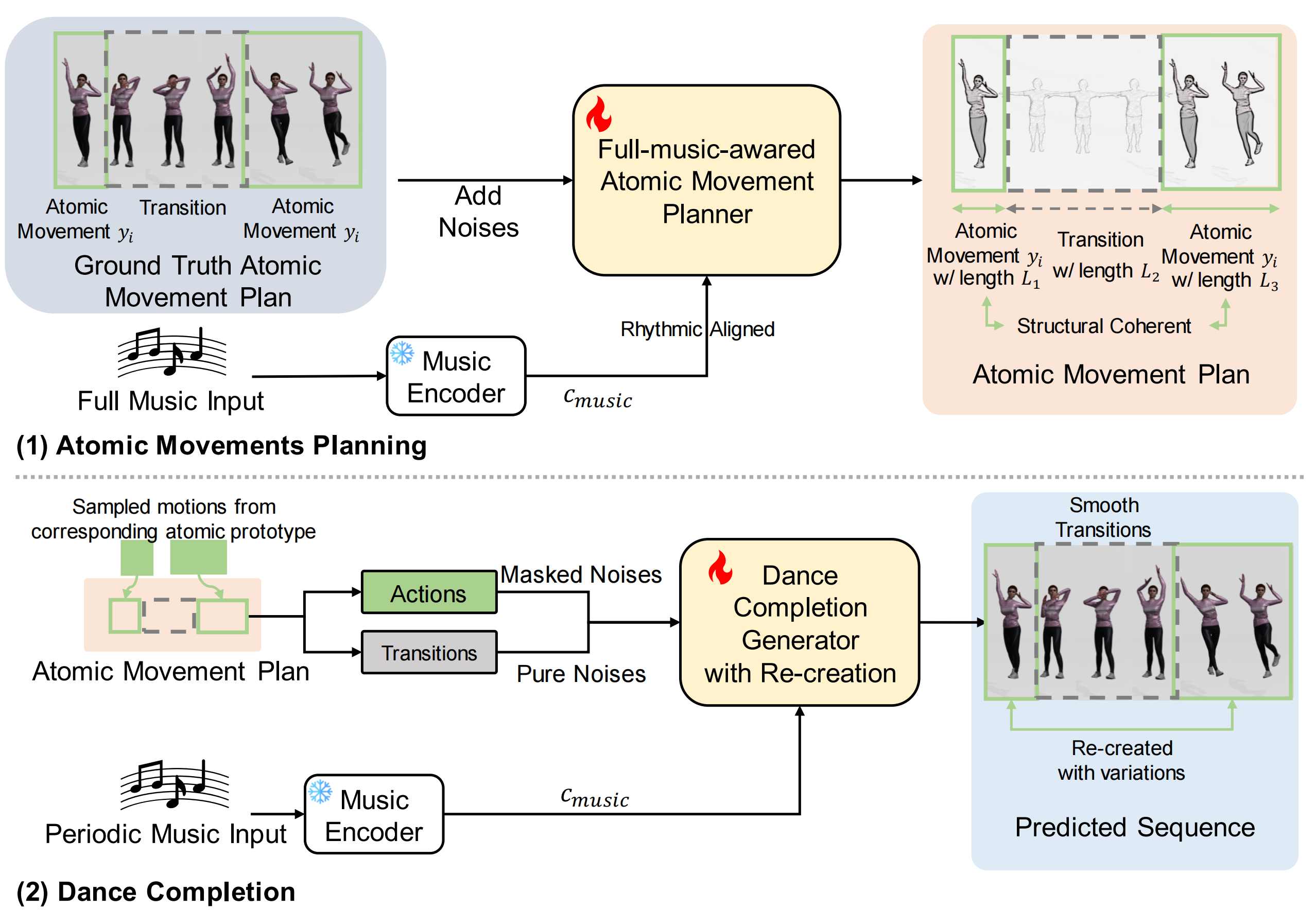
We first construct an atomic movement vocabulary by segmenting dance sequences, clustering recurring motion patterns, and refining their semantics with LLM-assisted relabeling. We then introduce a two-stage generation framework that mirrors the choreography process. A full-music-aware planner predicts the type, timing, and duration of atomic movements. A transition-aware diffusion model retrieves suitable movement prototypes, re-creates them with variations, and synthesizes smooth, musically aligned transitions. The explicit symbolic plan also enables users to replace movements, adjust durations, and edit dance structure without retraining.
Method Overview
1
Atomic Vocabulary
Segment dance sequences, cluster recurring movements, and assign interpretable atomic labels for choreography-level reasoning.
2
Music-Aware Planner
Predict atomic movement type, start time, and duration from the full music context to form a symbolic dance plan.
3
Dance Completion
Retrieve movement prototypes, synthesize variations, and generate smooth transitions with a transition-aware diffusion model.
Atomic Vocabulary Visualization
Atomic Movement Samples
Middle-hip-hop style: gliding, shuffle arms
Atomic movements in the same category exhibits diversity.
Visualization Results
Generated Results
Generated dance result 1
Generated dance result 2
Generated dance result 3
Under similar music condition, our model generate diverse dance results with different atomic movement plans.
Editing Results
Edited choreography result 1
Edited choreography result 2
Our Atomic Movement-based design supports user editing of generated dances. Such editing is more 1) interpretable, as users can select and replace specific types of atomic movements according to their needs; and 2) procedural and structured, since each edit is not performed rigidly at the frame level, but instead directly modifies a complete movement.
BibTeX
@inproceedings{cai2026atomicdance,
  title={Music-to-Dance Generation via Atomic Movements},
  author={Cai, Xinhao and Sun, Yixuan and Zheng, Minghang and Chen, Qingchao and Jin, Xin and Zhu, Song-chun and Liu, Yang},
  booktitle={European Conference on Computer Vision (ECCV)},
  year={2026}
}